Questions fleets ask before ordering a zoned body
The answers below cover zone design, fit, sealing, lead times, warranty, and verification. If your question is about a specific chassis or order mix, send it to engineering and we will answer it directly.
01 What does “multi-temperature” actually mean for a truck body?
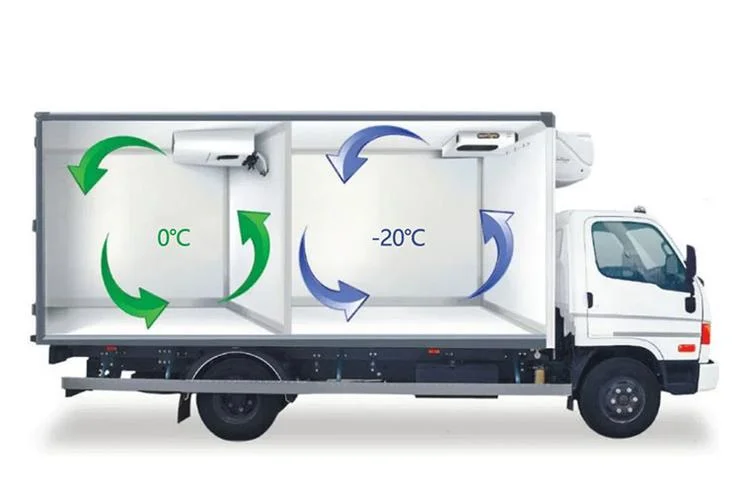
It means the cargo space is divided into two or more compartments by sealed insulated bulkheads, and each compartment is cooled by its own evaporator and controlled to its own setpoint. A three-zone body typically holds a frozen zone near −10 °F, a chilled zone near 34 °F, and an ambient or mid-range zone near 55 °F at the same time, on the same trip.
02 How many temperature zones can one body hold?
Our standard bodies are built with two or three zones. Fleet Build Program bodies can be configured with four zones where the load plan calls for it. Beyond four, the loss of usable cargo volume outweighs the benefit for most routes.
03 What is the difference between a single-temperature body and a multi-temperature body?
A single-temperature body holds the entire cargo space at one setpoint. A multi-temperature body separates that space into controlled zones. The practical difference is that a single-temperature truck forces a fleet to run separate vehicles for frozen and chilled product, while a zoned body delivers both on one route.
04 Will a zoned body fit my existing chassis?
In most cases, yes. We build to the chassis wheelbase, frame rail spacing, and cab-to-axle dimension you provide. Slip-in and bolt-on kits are sized for common light- and medium-duty chassis so the installation requires minimal modification. Send us the chassis make, model, and wheelbase and we will confirm fit before the order is confirmed.
05 Do the zones really stay separate when I open a door?
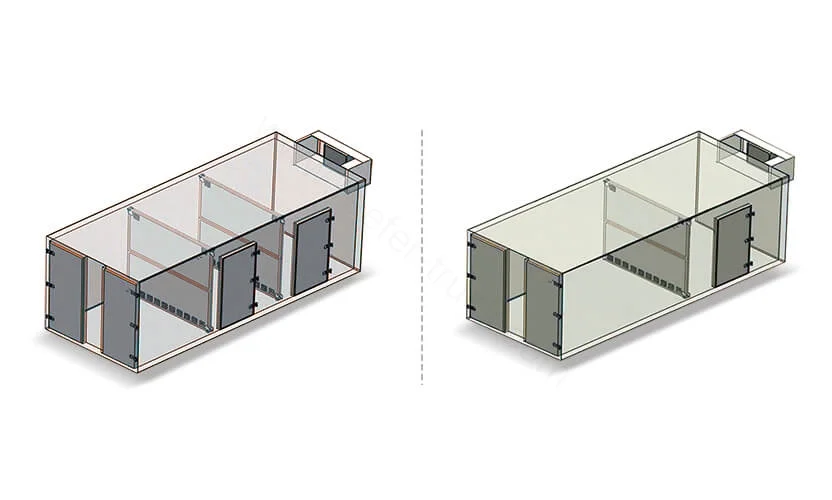
Yes, when the bulkhead is correctly sealed. Every bulkhead is gasketed and sealed to the roof, walls, and floor, and each zone has its own door. Opening the frozen door loads the frozen evaporator only; it does not pull ambient air through the chilled compartment behind it.
06 Can the bulkheads be removed or moved later?
On Tri-Zone 16 and Fleet Build Program bodies, one or more bulkheads can be specified as removable so the zone split can be changed as the order mix changes. Fixed bulkheads are used where the load plan is stable and maximum thermal separation matters more than flexibility.
07 How long does a build take?
Full bodies run 6 to 9 weeks from order confirmation to shipment. Flat-shipped slip-in and bolt-on kits run 3 to 5 weeks. Bulkheads and partition systems run 2 to 3 weeks. Replacement panels and hardware ship in 5 to 10 business days.
08 Do you install the refrigeration unit?
We integrate the compressor unit, evaporators, ducting, control wiring, and setpoints when the customer supplies the unit or specifies a model at the time of order. If the customer prefers to supply its own unit, we deliver the body with mounting provisions, pre-run wiring, and a documented connection schedule.
09 Can you convert the single-temperature body I already own?
Yes. Body Retrofit & Zone Conversion covers an interior survey, a new zone layout, bulkhead fabrication and sealing, added evaporator and ducting work, and reconfiguration of the existing control panel where the panel supports independent zones.
10 How do I prove the temperature stayed in range?
Every body ships with a zone map and setpoint schedule, and we run a pre-delivery setpoint verification that produces a printed per-zone record. A zone temperature data logger with a 12-month record is available as an add-on for fleets that need a continuous history.
11 What is covered by the warranty?
Structural warranty is 24 months on Duo-Zone 12 bodies, 36 months on Tri-Zone 16 bodies, and 48 months on Fleet Build Program bodies. It covers panel delamination, bulkhead sealing failure, and door hardware defects under normal operating conditions. Wear items such as door gaskets are covered for the first 12 months.
12 How are the bodies maintained?
Fleet Service covers scheduled visits for bulkhead and door seal inspection, gasket replacement, airflow checks, drainage and floor inspection, and a setpoint verification run with a printed zone record per vehicle. We recommend one service visit every six months for vehicles running daily multi-stop routes.
13 What temperature range can the zones hold?
Frozen zones are typically set between −20 °F and −5 °F, deep-chill zones between 0 °F and 28 °F, chilled zones between 30 °F and 41 °F, and mid-range or ambient zones between 50 °F and 65 °F. Exact holding performance depends on ambient conditions, door-opening frequency, and load density, and is stated in writing on the order confirmation for each build.
14 Do you deliver outside the Louisville area?
Yes. We ship nationwide from Louisville, Kentucky. Freight is quoted by destination ZIP code, and pick-up at our facility is available at no freight charge. For customers outside the continental network, production slots are quoted at the time of order.
15 Which configuration should I start with?
If you are replacing a single-temperature body and running one route, Duo-Zone 12 is the practical starting point. If your stops receive more than one temperature category and your order mix changes week to week, Tri-Zone 16 is the better fit. If you are standardizing four or more vehicles on one specification, a Fleet Build Program and interchangeable parts will save more across the order than any difference in the per-body price.
16 How is a body priced?
We do not publish a fixed price list. A refrigerated body is quoted per project, because body length, zone count, door positions, refrigeration system, delivery distance, and order volume each move the number. Every configuration page shows a planning range so you can budget before you call, and the written quotation we issue after reviewing your load plan and chassis holds its price for 30 days.
17 What do you need from me to quote?
Chassis make, model, cab-to-axle measurement, and wheelbase; the number of temperature zones you need and the setpoint for each; how many stops each route serves and which zones open at each stop; the product categories you carry; and your delivery ZIP code. With those details we can confirm fit and return a written quotation in one reply instead of trading emails.
Still deciding between two and three zones?
Tell us what each stop receives and how often the doors open. We will recommend the zone count that holds your product without wasting cargo volume.
- 502-555-0583
- support@variocold.com
- Engineering questions answered within 1 business day